The Scroll That Never Ends
Picture this: you open TikTok just to watch a “quick” video. Twenty minutes later, you’ve scrolled through dozens of clips, laughed at memes, half-watched a cooking hack, and almost forgot why you picked up your phone in the first place.
Now imagine this happening every day. For some, this cycle doesn’t just waste time, it starts to affect how long they can focus on anything at all.
This raises a big question: can social media cause ADHD? Or does it simply make ADHD-like symptoms worse? Scientists, parents, and educators are asking this more than ever, especially as diagnoses of ADHD have risen in recent decades.
What ADHD Really Is
ADHD stands for Attention-Deficit/Hyperactivity Disorder. It’s a neurodevelopmental condition, not just a personality trait. Symptoms usually fall into three categories:
- Inattention: Trouble focusing, being easily distracted, forgetful
- Hyperactivity: Restlessness, difficulty staying still
- Impulsivity: Acting without thinking, interrupting others
Traditionally, ADHD was most often diagnosed in children. But today, it’s widely recognized in adults as well. Importantly, ADHD has a strong genetic and neurological basis – meaning it’s not caused by lifestyle alone.
So where does social media come in? Let’s explore.
The ADHD-Social Media Connection: Why People Wonder
Social media is designed around fast, bite-sized content. TikTok, Instagram Reels, YouTube Shorts – all thrive on short attention spans. You watch one clip, then the algorithm instantly serves another.
This design has led researchers to ask: could long-term use of these apps actually train the brain to expect constant novelty, making it harder to focus on slower tasks like reading, studying, or working?
Research on Social Media and Attention Problems
Study 1: Teens and ADHD Symptoms
A 2018 study published in JAMA (Journal of the American Medical Association) followed more than 2,500 adolescents for two years. Those who used digital media heavily were twice as likely to develop ADHD-like symptoms compared to peers who used it less.
This doesn’t prove social media causes ADHD, but it shows a strong association.
Study 2: Brain Activity
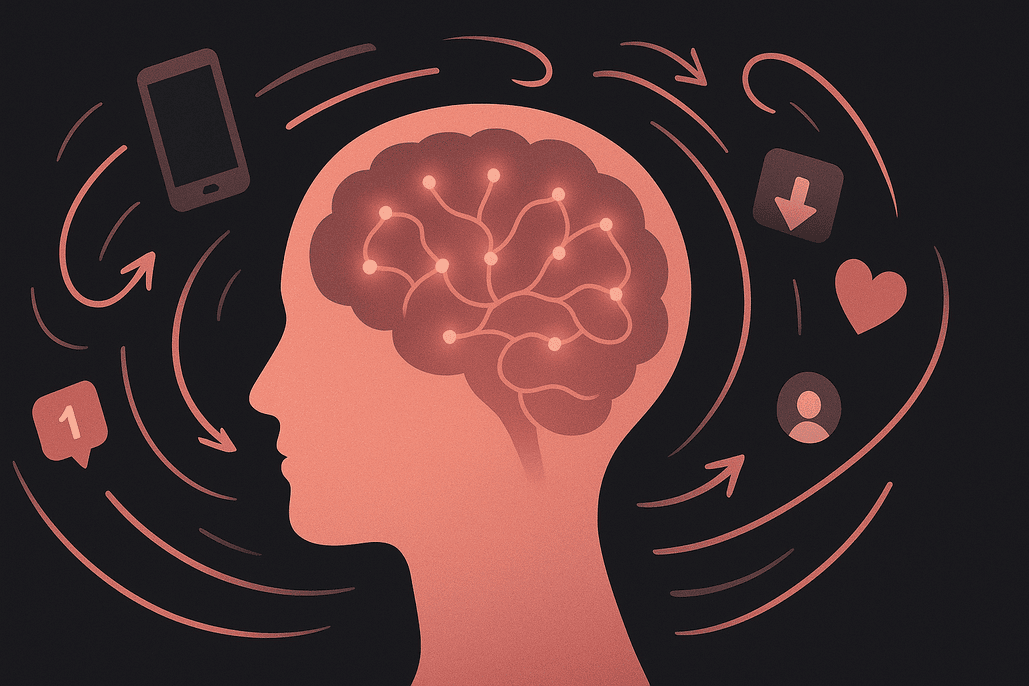
Neuroimaging studies suggest that frequent social media use activates brain pathways linked to reward and impulsivity. These are the same pathways often implicated in ADHD. Constant “pings” of dopamine from likes, comments, and new content may make it harder to regulate attention over time.
Study 3: Adults and Distraction
A 2021 study from the University of Arkansas found that heavy social media users reported higher distractibility and difficulty sustaining attention, even when they didn’t have ADHD diagnoses.
Imagine This: A Student’s Story
Let’s take Alex, a high school student, as an example. He sits down to study history for a test. After ten minutes, his phone buzzes with a notification. He checks it, thinking it’ll only take a second. Suddenly, he’s scrolling for twenty minutes.
When he returns to his textbook, he can’t remember where he left off. He feels restless, bored, and frustrated. This cycle repeats daily.
Alex doesn’t necessarily have ADHD – but his attention span is being shaped by constant digital interruptions, and it looks a lot like ADHD behavior.
Does Social Media Cause ADHD?
Here’s what experts agree on:
- ADHD is not caused by social media. It’s a medical condition with genetic and neurological roots.
- Social media can worsen attention problems in people who already have ADHD.
- Heavy use can mimic ADHD symptoms in those without the condition – like forgetfulness, distractibility, and impulsivity.
So while social media doesn’t cause ADHD, it can create or intensify ADHD-like behaviors.
Why the Brain Loves Social Media
The human brain craves novelty. Every time you scroll and see something new, your brain rewards you with dopamine. This constant stimulation rewires the brain to prefer fast, changing content.
I’ve noticed this in my own life. I used to read books for hours when I was younger, but after getting access to a mobile phone and social media, it became harder to sit down and finish even a few pages. My attention span felt shorter, and I found myself reaching for my phone whenever I got bored.
But the downside is clear:
- Reading a long article feels boring
- Listening to a 30-minute lecture feels impossible
- Waiting without a phone feels unbearable
These are the exact struggles many people with ADHD face.
Children and Teens: The Most Vulnerable
Younger brains are more flexible, which makes them more vulnerable.
- The American Academy of Pediatrics warns that excessive screen time is linked to attention problems, poor sleep, and emotional issues in children.
- A Canadian study found that children who spent more than 2 hours a day on screens scored lower on attention and memory tests.
This doesn’t mean every child on TikTok will develop ADHD – but it shows a pattern worth paying attention to.
Adults Aren’t Immune
Adults often believe ADHD is only a childhood issue, but heavy social media use can also impact grown-ups. Workers report difficulty concentrating on tasks, switching constantly between tabs, and feeling unable to sit through long meetings.
One survey found that 67% of employees check their phones during work meetings, often multiple times. This constant distraction reduces productivity and mirrors ADHD-like patterns of restlessness and inattention.
ADHD, Social Media, and Sleep
There’s another layer to the story: sleep. People with ADHD already struggle with sleep, and social media makes it worse.
- Blue light delays melatonin production, making it harder to fall asleep
- Constant scrolling before bed overstimulates the brain
- Poor sleep intensifies inattention and impulsivity the next day
So even if social media doesn’t cause ADHD, it creates conditions that amplify ADHD symptoms.
The Debate Among Experts
Some scientists argue we should be cautious. Just because heavy social media use is linked with attention problems doesn’t mean it causes ADHD. It could be the other way around – people with ADHD may simply be drawn to social media because it fits their need for novelty and stimulation.
Others say the relationship is two-way: ADHD makes social media more appealing, and social media makes ADHD symptoms harder to manage.
How to Protect Attention in a Digital World
For Parents:
- Set screen-time limits for kids and teens
- Encourage offline activities like sports, music, or reading
- Keep phones out of bedrooms at night
For Students:
- Use the Pomodoro technique: 25 minutes of focused work, then a 5-minute break
- Turn off notifications during study time
- Replace endless scrolling with mindful breaks
For Adults:
- Create phone-free zones like the dinner table or bedroom
- Use apps that track and limit social media usage
- Practice mindfulness to rebuild focus and patience
FAQs
Can social media cause ADHD in children?
No. ADHD is a neurodevelopmental disorder. But heavy social media use can trigger attention problems that look like ADHD symptoms.
Why does social media feel addictive?
Because it taps into the brain’s reward system. Each notification or new post releases dopamine, reinforcing the habit.
Are some platforms worse than others?
Apps with short-form, rapid content (TikTok, Instagram Reels, YouTube Shorts) are more likely to impact attention than long-form platforms.
Should people with ADHD avoid social media?
Not completely. But they should use it carefully, with limits, since it can worsen existing symptoms.
Taking Back Control
So, can social media cause ADHD? The evidence says no – it cannot create the disorder itself. But it can make ADHD symptoms worse and mimic ADHD-like behaviors in people who don’t have the condition.
In a world of constant notifications, short videos, and endless feeds, our attention has become a precious resource. Protecting it isn’t easy, but it’s possible with boundaries, mindfulness, and balance.
Social media can connect, inspire, and entertain. But it shouldn’t control how long we can focus, think, or live.